Forge — our own growth engine
Forge is the internal platform we built to run Codifyany's growth marketing. It does two jobs for each client: an outbound engine that discovers and qualifies leads, audits their sites and drafts approval-gated outreach; and client reporting that tracks a client's own web health and demand over time. It is a working example of the custom internal software we can build for you.
Two jobs for every client
The outbound engine moves through a fixed sequence — find, qualify, audit, write, approve, send — and each step writes its result to the database before the next runs, so the whole pipeline is inspectable and every email that goes out is one a person signed off. The reporting side is ongoing: connect a client's Google accounts once, then watch traffic, calls and audit trends over time and re-run audits whenever you need a fresh picture. Forge is multi-client — every page is scoped to the client selected in the sidebar.
How data flows into Forge
Everything Forge shows is pulled live from external sources, processed by one of the engines in the middle, persisted to Postgres, and then surfaced in the dashboard, pushed out to Slack and Resend, or read back into Claude through the MCP connector. The animated lines show the direction data travels.
- Grey lines (inbound) — raw data being pulled in: search results, scraped websites, Google API responses, CSV rows.
- Gold lines (outbound) — processed results leaving Forge: dashboard views, Slack alerts, approved email sequences, and read-only pulls into Claude through the MCP connector.
- Nothing flows right without passing through Postgres first — every lead, audit and draft is persisted before anyone acts on it, so there is always an audit trail. The MCP connector reads from that same store, scoped to the signed-in user.
Two ways Forge works with Claude
Forge is built by an AI company, so it treats a large language model as part of the product — but always behind sign-in, scoped access and a person's approval where it counts.
A secure MCP connector
Forge runs its own Model Context Protocol server, so you can add it to Claude Desktop or claude.ai and ask for a client's audit history or their Google Analytics and Business Profile numbers in plain language. Sign-in is the normal Forge login over OAuth 2.1 with PKCE — no API key to paste or leak. Every tool call is re-checked against your role and client access on the spot, the tools are strictly read-only, and revoking a connection from Settings kills its tokens on the server immediately.
Merlin, the built-in AI assistant
Merlin is Forge's own AI chat assistant — the wizard button in the corner of every page. Ask it to tighten an ICP, rewrite the day 1 to day 14 outreach prompts or flip an auto-nurture setting, and it makes the change and tells you exactly what it changed. It can read your leads, but it never sends an email, deletes a record or touches a credential — those stay behind an explicit human action.
A small, boring stack that stays up
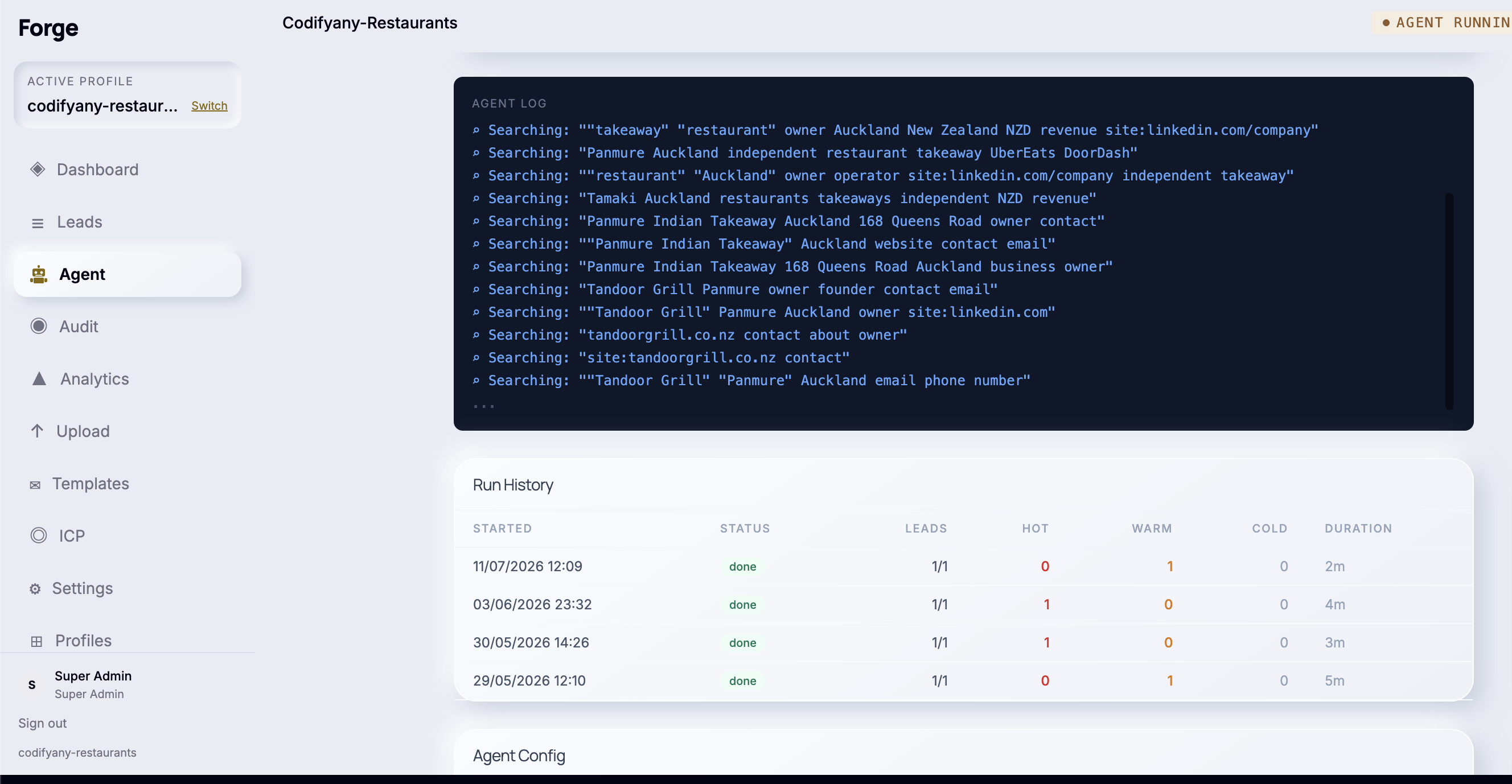
Forge is a Next.js app on Vercel with a Postgres database. Lead discovery and qualification run Claude in an agentic loop with a web-search tool and an in-house scraper; the audit engine fires around a dozen network checks in parallel and pulls real data from Google PageSpeed, Safe Browsing and the Wikipedia API. Outbound email goes through Resend on a daily schedule.
Two rules shape the whole thing. Every external call has a hard timeout, so a slow third-party site produces a skipped check rather than a failed run. And anything that can't be measured directly is marked as skipped, never estimated — no invented authority scores, no fake numbers.
Screens from Forge
Lead discovery & qualification
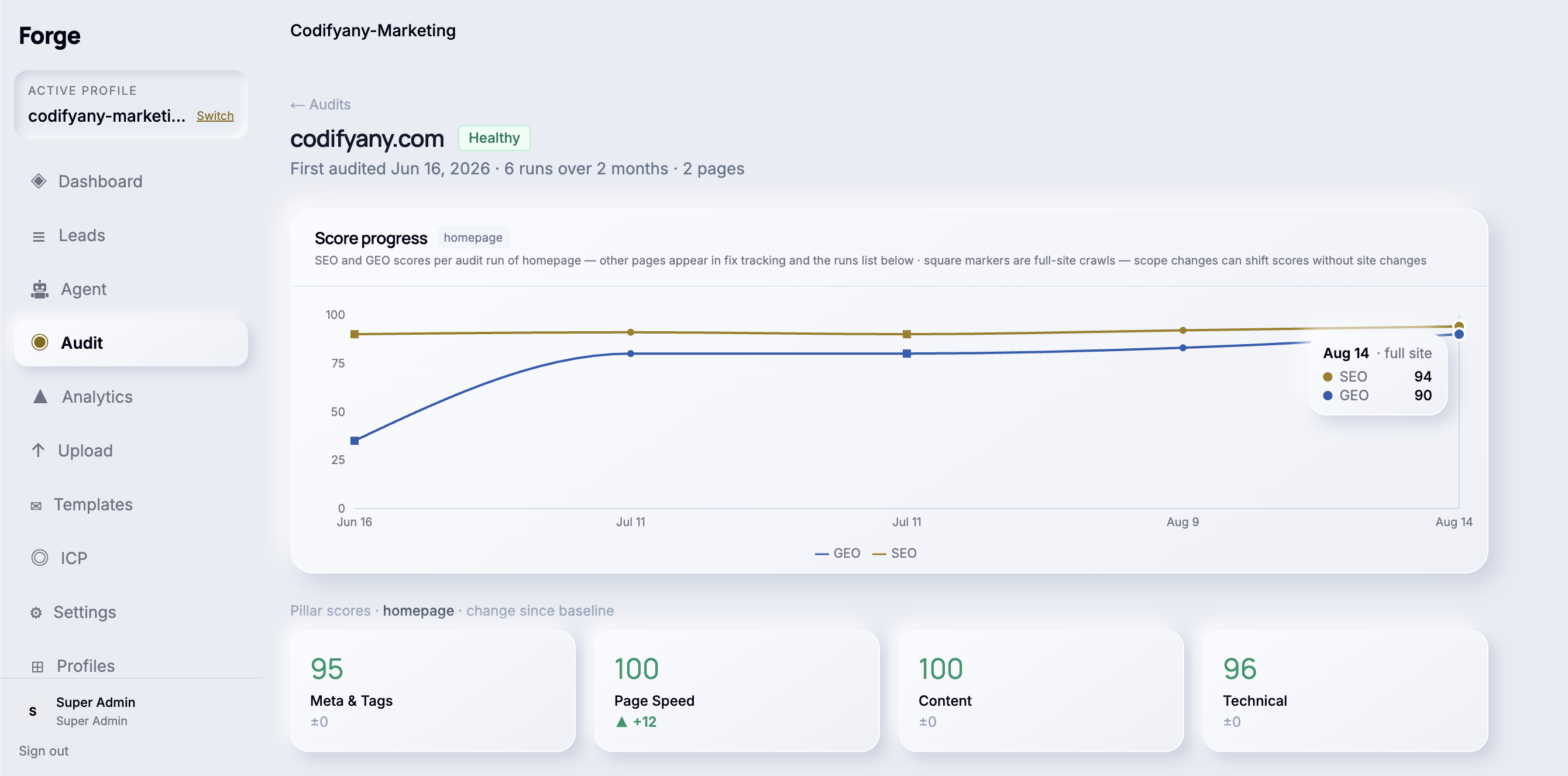
SEO & GEO website audit
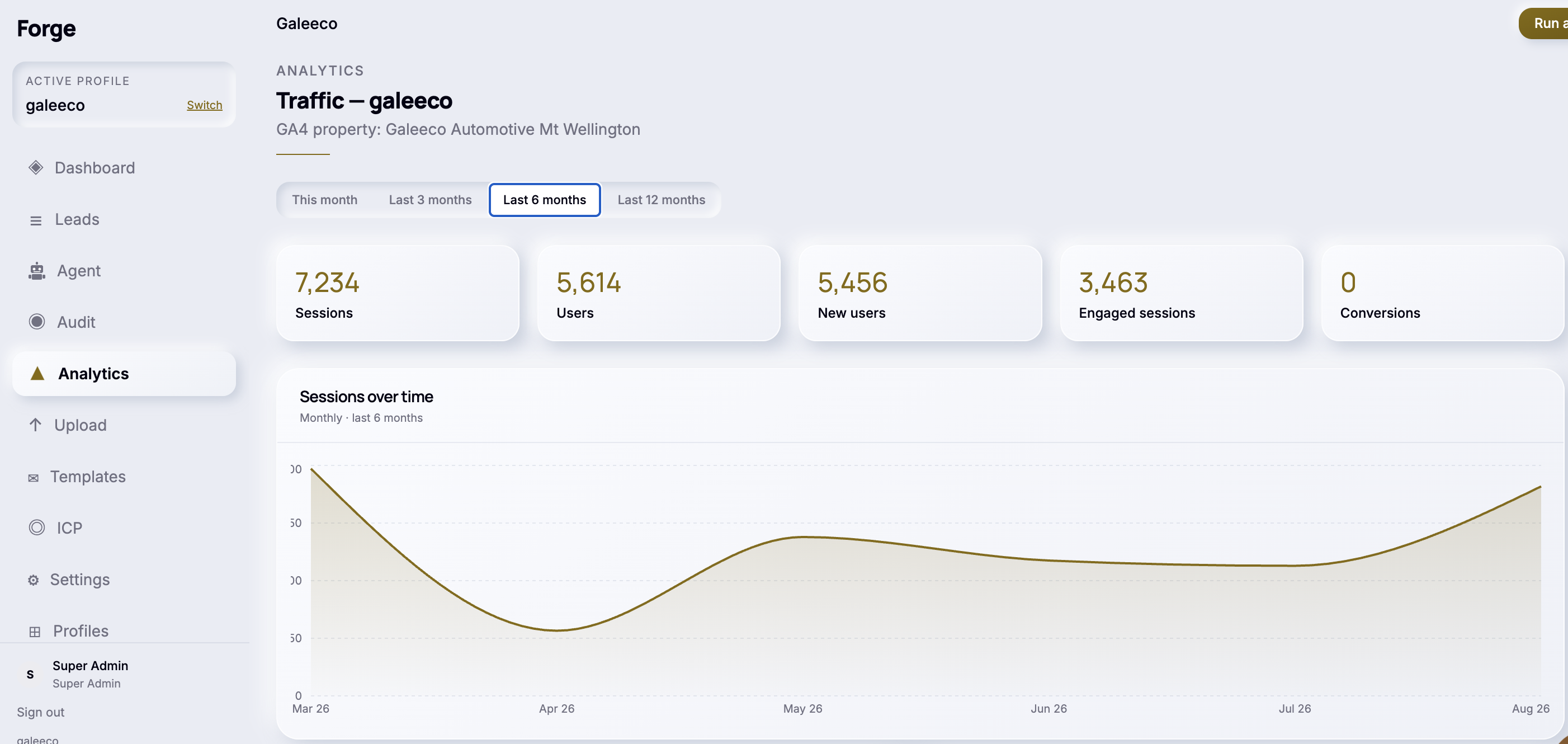
Live analytics
What we can build for you
Forge is the kind of software we build for clients too — internal tools that replace a pile of spreadsheets and manual steps with one dependable app.
Internal dashboards
One place for work that is currently spread across spreadsheets, tabs and disconnected apps.
Lead & pipeline tools
Capture, scoring, funnel tracking and alerting built around how your team actually qualifies work.
Audit & reporting engines
Automated checks against a website, an account or a dataset, turned into a shareable report with fix guidance.
Workflow automation
Multi-step processes with approval gates, scheduled jobs and integrations to the services you already use.
AI features that are honest
LLM steps where they help — drafting, classifying, summarising — with a person in the loop and no invented numbers.
Client-scoped multi-tenant apps
One tool, many clients or locations, each with isolated data and its own configuration.
Forge, in short
Forge is the internal platform Codifyany built to run its own growth marketing. It does two jobs for each client: an outbound engine that discovers leads against an ICP, qualifies them with scoring and tiering, runs SEO and GEO audits from roughly forty automated checks, and drafts approval-gated outreach emails; and client reporting that tracks Google Analytics traffic, Google Business Profile calls, and audit score trends over time. It is multi-client — every page is scoped to the client selected in the sidebar.
Forge runs its own Model Context Protocol (MCP) server, so you can add it to Claude Desktop or claude.ai and query a client’s audit history, Google Analytics numbers or Business Profile data in plain language. Sign-in is the normal Forge login over OAuth 2.1 with PKCE — no API key to paste or leak. Every tool call is re-checked against your role and client access, the tools are strictly read-only, and revoking a connection from Settings kills its tokens on the server immediately.
Merlin is Forge’s own AI chat assistant — the wizard button in the corner of every page. Ask it to tighten an ICP, rewrite the day 1 to day 14 outreach prompts or flip an auto-nurture setting, and it makes the change and tells you exactly what it changed. It can read your leads, but it never sends an email, deletes a record or touches a credential — those actions stay behind an explicit human approval.
Forge is a Next.js app on Vercel with a PostgreSQL database. Lead discovery and qualification run Claude in an agentic loop with a web-search tool (Brave Search API) and an in-house scraper (Cheerio). The audit engine fires around a dozen network checks in parallel, pulling real data from Google PageSpeed, Safe Browsing and the Wikipedia API. Outbound email goes through Resend on a daily schedule, and hot and warm lead alerts are sent to Slack. Every external call has a hard timeout, and anything that can’t be measured directly is marked as skipped — never estimated.
Yes. Forge is a working example of the custom internal software Codifyany builds for clients: internal dashboards, lead and pipeline tools, audit and reporting engines, workflow automation with approval gates, AI features with a human in the loop, and client-scoped multi-tenant apps. Book a free 30-minute consultation — describe the spreadsheets and manual steps you want to replace, and we will tell you honestly whether a custom tool is worth building.
Tell us what your team does by hand.
Book a free 30-minute call. Describe the spreadsheets, the copy-paste and the tabs, and we will tell you honestly whether a custom tool is worth building.